
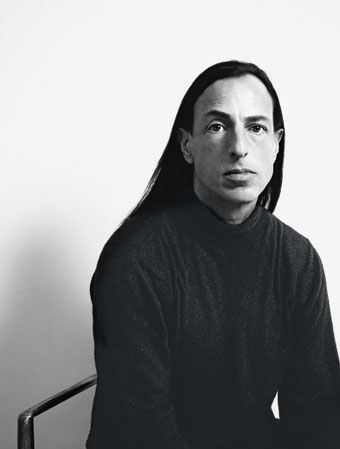
Rick Owens first runway show was staged at New York Fashion Week in 2002 of his self titled
gothic inspired “glundge” styles, it was a sponsored show by Vogue magazine in celebrating Owens
as an emerging designer from Los Angeles and his distinct take on 1990s grunge fashion, infused
with Owens fascination of 1970s epicurean glamour. He was 41 at the time. To look at this
retrospection of the famed avant-garde designer, is also an attempt, despite what might appear to be
an unintended ambiguity, which maybe a conscious or an unconscious history of disarray. It is
Owens trade mark styles, with his accentuation and unique ability to overlay fits into a dark
ensemble, which in turn cleverly portrays his crafted and exclusive reduction of styles; from
asymmetrical cuts to skin tight looks, the aesthetics on display reflects the singled minded
dedication that Owens has in formulating his collections. Owens Fall 2002 Ready-To-Wear debut
offers a slight historic glimpse into the Rick Owens continuum, a show that was solely directed
towards his faithful buyers, loyal fan base and more importantly the niche avant-garde clothing
market. To which Owens had, over the years, cleverly moulded in building up his brand to become
a formidable template in light of his first RTW collection. This was no overnight sensation, nor a
star pupil of a renown fashion school breaking into the industry. Owens had been working tirelessly
since 1994, eight years prior to the 2002 showing, on his namesake label and here lies the
manifestation of a tale filled with an intriguing narrative that is Owens first arrival onto the L.A.
fashion scene – all set within his carefully timed and orchestrated plays, that you would expect from
the shrewd designer. From his initial beginnings, Owens has been able to maintain an
uncompromising integrity of his signature label, which stands today as one of the last of the bigger
independent fashion brands.

After finishing school in the mid 1980s, Owens went onto to study at the Otis College of Art and
Design in Los Angeles, after a brief stint of just two years, he dropped out. He then went onto to
study at the L.A. Trade Technical Collage as a pattern cutter, to which he completed his studies in
the early 90’s. In an attempt at trying to find suitable employment and aware of the ‘knock offs’ of
designer leather goods, Owens was able to work with ‘Korean’ (based in L.A.) imitation luxury
retailers, cutting patterns for the fake designer products from the iconic fashion houses of Europe.
There is an irony in all of this, more so the fact that Owens’s start was specifically centred around
his L.A. street artfulness, in this unorthodox entry into the fashion world, in so many ways reflects
his own iconoclastic and at times, ambiguity. Yet, this is Owens as a self created icon, with roots
firmly set within the 1990s of Los Angeles. In a pre-digital interconnected world, were
entrepreneurialism was seen as a given, for the many who had hopes and dreams of becoming the
next big thing, for Owens the 90’s resonated a possibility of configuring his take on gothic/grunge
and glamour envisioned styles, turning them into a viable product. A uniquely Owens Hollywood
Boulevard story, that mirrors a romantic surrealism, as a visible participant of the L.A. nightclub
scene, to which Owens frequented the city’s many underground clubs, where he met the enigmatic
and creative entrepreneur Michèle Lamy.

A Hollywood darling for the many celebrities that attended her two cafeterias in L.A. throughout
the late 90’s, Lamy herself was no native to the glamorous West Coast scene, she was born in Paris
in 1944, who left France for America in the 1970s, she quickly became a recognisable figure of the
New York City ‘Studio 54’ years, moving to Los Angeles in late 70’s, she began to immerse herself
within the art, cinema and fashion industry of L.A., where she met her first husband and business
partner Richard Newton, the experimental artist and film-maker. The crucial element in the Rick
Owens success story is Lamy’s firm imprint she and her first husband had at the time, over the L.A.
club and fashion scene. When she created her fashion line Lamy in 1990, she hired Owens, who
was introduced to Lamy by Owens’s then boyfriend, as her new business partner to assist in
designing the collections, to which they became a couple soon after. Lamy subsequently folded her
label in the mid nineties to focus on the Le Deux café which was situated on a parking lot behind
the famous Hollywood Boulevard, after buying a dilapidated former ‘crack house’ for $5,000 and
setting it down onto the vacant car park. In a true reflection of Lamy’s eccentricity, she recreated a
French inspired café within its American urban surreality. When Owens begin to work on debuting
his signature brand in 1994, Lamy quickly became his muse wearing and representing the layered
and gothic looks, whilst she continued running the celebrity hot spot. It would be the now defunct
avant-garde Charles Gallay boutique on Sunset Boulevard, that was once run by Madeleine and
Charles Gallay, known to be exclusive retailers for the Hollywood elite. With the proprietor
Charles Gallay buying large selections of Owens designs, being the first to provide financial
support, it also showcased this new designer from L.A. to the young rich trend setters. Owens first
sell to a Los Angeles boutique paid off, as the larger store Maxfield took note, soon becoming a
more substantial buyer, which continues to this day, of the Rick Owens label. Lamy’s Le Deux café
was shelved after issues she had in 1997 of the actual ‘house’ collapsing and the rising costs of
maintaining the endeavour. In the final years of the 90’s a switch occurred with Owens leading the
creative helm of his brand with Lamy, his soon-to-be-wife, overseeing the business dealings. Yet,
what might seem to be a reversal of fortunes, was balanced equally on the couple’s interest of the
hedonistic, Lamy maybe the enchanting Gothic like character with her plethora of contacts and
Owens the edgy designer who flirts with oblivion — however L.A. regardless of the romanticism is
notorious for chewing up and spitting out the idealist, with or without that taste for fame. To which
Owens was quoted in an article, “…I was going to make beautiful things and live in glamorous
squalor on Hollywood Boulevard and die the hero for having stuck to my vision and not
compromised.”

However, oblivion did not beckon and Owens and Lamy set forth to reinstate a next chapter for the
new century which began via a photographic editorial for Vogue France in 2001, with Kate Moss
adorning a Rick Owens leather jacket. Photographed by the late Corinne Day, the image caught the
attention of Vogue editor in chief Anna Wintour, who, organised to sponsor Owens Fall/Winter 2002
runway show for New York Fashion Week.
In 2013 Rick Owens and Michèle Lamy left Los Angeles and relocated to Paris, forming a partnership company called Owenscorp and in 2006 they got married.